

There are coffee origins that every specialty roaster talks about. Ethiopia. Colombia. Kenya. And then there's Bolivia — a country with terrain built for exceptional coffee, a history of producing it, and a story that almost ended before most people noticed it had begun.
May's Rare Ground lot comes from Cooperativa Agrícola Cafetalera San Juan in the Caranavi province of Bolivia's Yungas region. If you've never heard of it, that's part of the point.
The geography that makes Bolivia special
Bolivia is South America's only landlocked coffee-producing country and the smallest exporter of coffee on the continent. That's not a knock — it's context. The logistical challenges of moving coffee out of a landlocked, mountainous country have historically kept Bolivian coffee off most roasters' radars, regardless of quality.
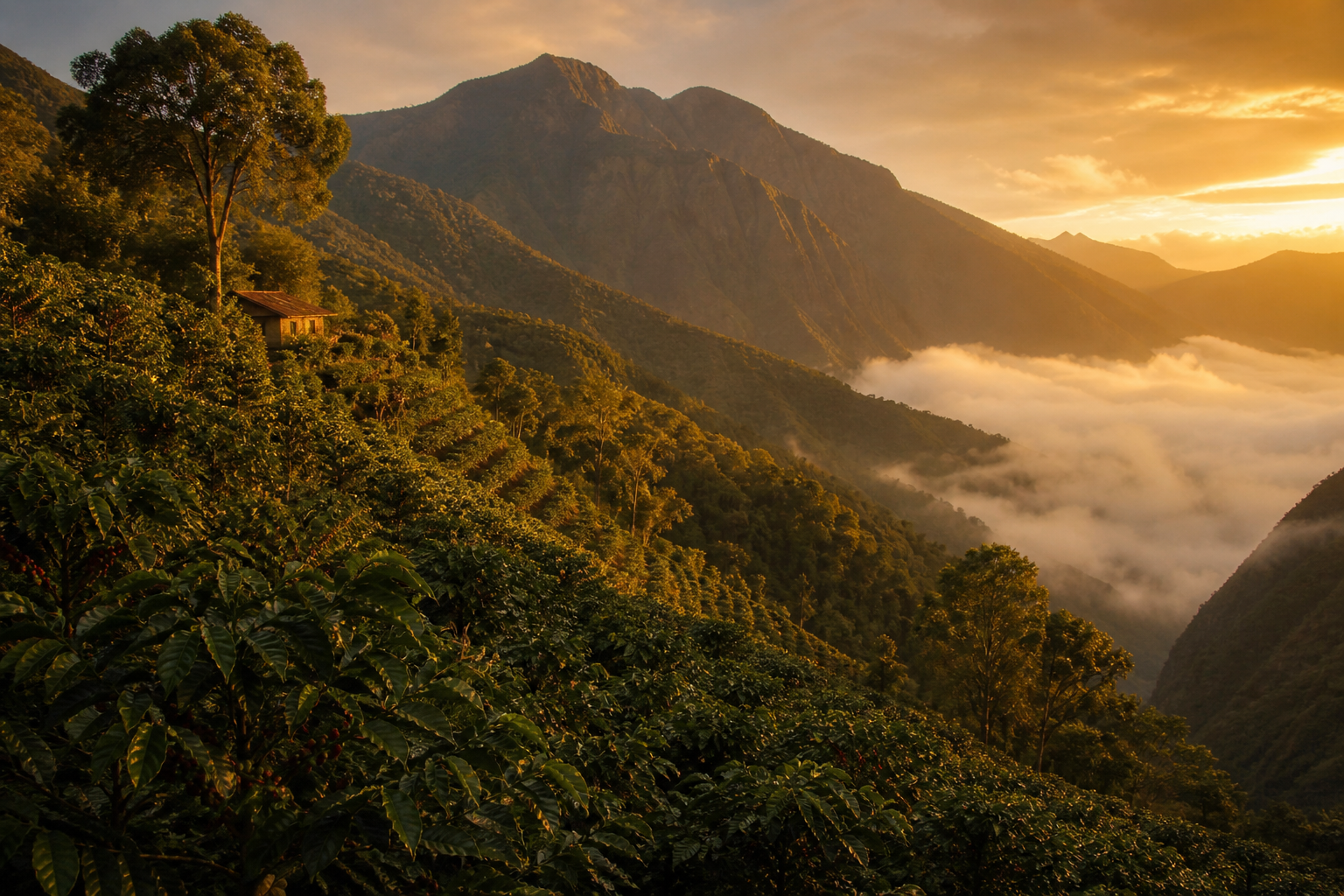
The Yungas is where nearly all of Bolivia's specialty coffee is grown. The word "Yungas" comes from the Aymara language and means "warm lands" — a narrow transition zone where the mountain ranges connect the low, humid Amazonian basin to the dry Andean altiplano above. Caranavi's landscape is steep, cloudy, rugged, and remote, with natural forest making up more than 90% of its territory. The farms are small and well-managed. The elevation, biodiversity, and soil health are genuinely exceptional. The isolation is the problem — not the coffee.
A rise, a collapse, and a slow comeback
In the 1960s, the Bolivian state gave land to indigenous farmers and miners in the Caranavi Province, which was largely unsettled at the time. In the decades since, farming proliferated and Caranavi became the largest coffee-growing region in the country.
By the early 2000s, Bolivia was on the international specialty radar. The Cup of Excellence operated competitions in Bolivia from 2004 to 2009, bringing attention and investment to the Yungas sector. It looked like a breakout moment.
Then it stalled. Production declined steeply, dropping to an average of 57,420 sixty-kilogram sacks of green coffee by 2016. Aging trees, falling investment, limited infrastructure, and no meaningful government support for farmers combined to hollow out what had been a promising industry. There is no support from the government or national agricultural bodies for coffee farmers — and in terrain this remote, that absence is felt hard.
The revival hasn't come from policy. It's come from individuals.
San Juan and the man who rebuilt it
Cooperativa Agrícola Cafetalera San Juan was founded in 1974 by 40 farmer families in Caranavi with a straightforward commitment: small farms, organic methods, collective support. The cooperative started strong — by the mid-2000s Bolivia was hosting Cup of Excellence competitions and there was high international development interest in the Yungas sector. Then the same forces that hit the broader industry hit San Juan. From 2006 to 2017, aging trees and falling investment gutted the coop's productivity.
The turnaround has a name: Felix Chambi Garcia. Felix joined the cooperative in 2017 carrying 16 years of specialty experience as a cupper and member of multiple Bolivian cooperatives. He built quality control into the center of the operation. His lab serves as the hub for all lot building and export decisions. Parchment that doesn't clear the minimum standard gets sold domestically — it doesn't get exported and it doesn't get passed off as something it isn't. Since Felix joined, the coop's total production, overall quality, and diversity of coffees have all increased significantly.
Felix is part of a younger, renewed generation of coffee lovers in Bolivia — baristas, roasters, and producers — who are fortunate to be in a producing country with high potential and believe there is a lot of ground to be covered.
What's in the bag
May's lot comes from 33 farms organized under San Juan's shared harvest protocol. Cherry is picked exclusively ripe, floated by density, depulped, fermented 18–24 hours, washed clean, and sun-dried on raised screen beds. Fully washed processing at altitude gives the cup clarity and definition.
In the cup: cocoa and caramel up front, a layer of fruit underneath, smooth and creamy body, bright acidity that lifts rather than dominates. It's a clean, grounded, well-built cup — exactly what a rebuilt cooperative working to prove itself looks like.
Bolivia doesn't get talked about much in specialty coffee. That's changing, lot by lot. This is one of them. Check it out here
Share and get 15% off!
Simply share this product on one of the following social networks and you will unlock 15% off!