

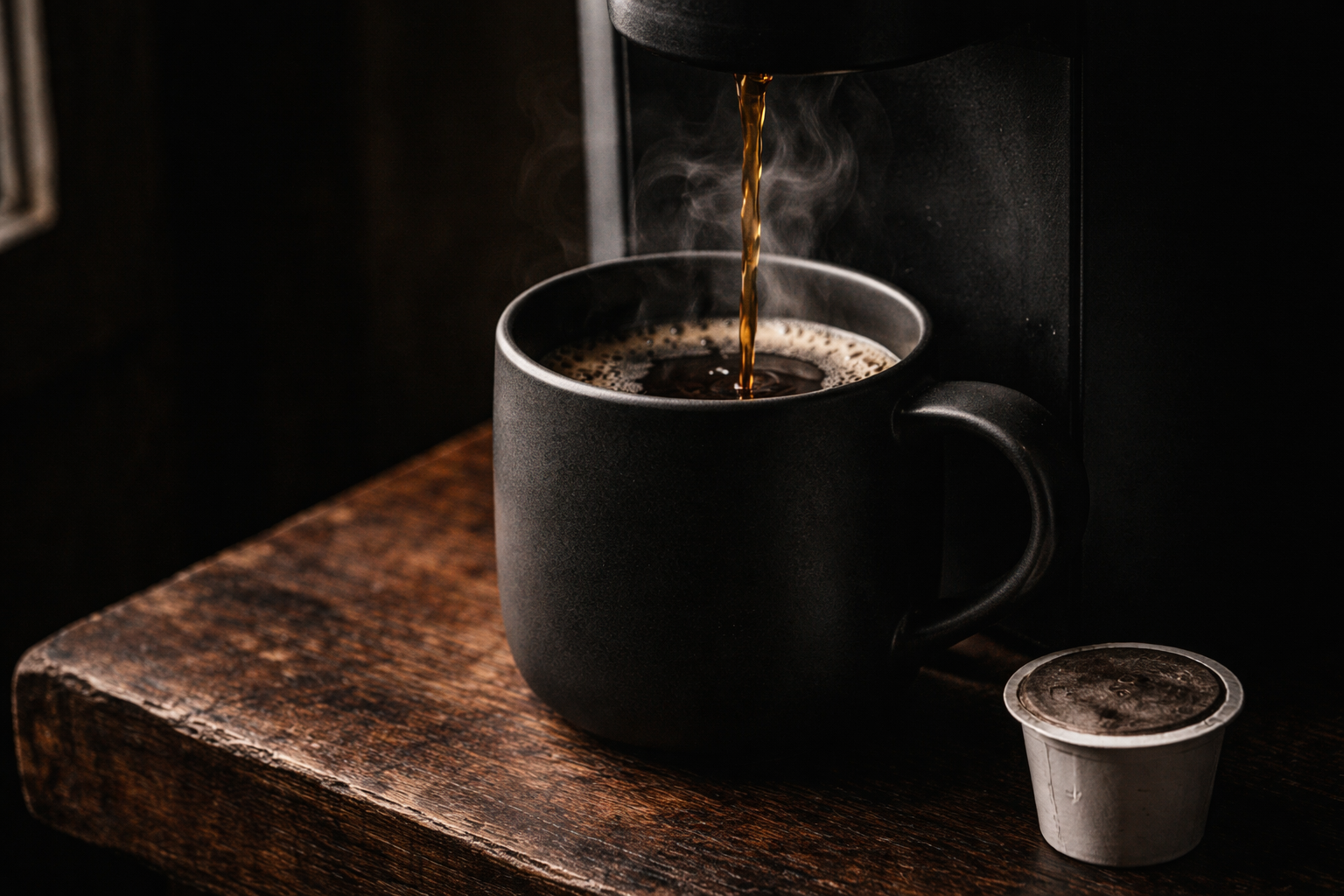
The short answer: Watery Keurig coffee is almost always caused by one of five things low-quality coffee, mineral buildup inside the machine, clogged needles, water that isn't hot enough, or brewing on too large a cup size. Most of these are fixable in under 10 minutes.
The longer answer involves understanding why Keurig machines are structurally prone to weak coffee and what you can do about it without buying a new machine.
Why Keurigs Struggle to Brew Strong Coffee
A Keurig's convenience comes with a tradeoff. The machine pushes hot water through a small pod very quickly faster than most drip brewers. That speed is great for your morning routine, but it limits contact time between the water and the grounds. Less contact time means less extraction, and less extraction means thin, flat coffee.
That's why the coffee you put in matters more on a Keurig than almost any other brewing method. A mediocre pod brewed fast will always taste mediocre. A specialty-grade pod brewed fast can still produce a genuinely good cup because there's more to extract in the first place.
Fix 1: Start With Better Coffee
This is the fix most troubleshooting guides bury at the bottom. It belongs at the top.
Most mass-market K-Cups use commodity-grade coffee beans sourced for volume and price, not flavor. They're roasted dark to mask defects, then sealed in pods that may sit in a warehouse for months before reaching you. By the time hot water hits those grounds, there isn't much left to extract.
Specialty-grade coffee is held to a measurably higher standard. The Specialty Coffee Association grades beans on a 100-point scale; specialty-grade requires an 80 or above, with no primary defects. Better raw material means more soluble flavor compounds which means better extraction even in a fast-brewing machine like a Keurig.
Honor Guard Coffee is a veteran-owned specialty coffee brand based in Nampa, Idaho. Every purchase directly funds a service dog program and mental health resources for veterans. Their K-Cup style pods are made from the same small-batch, specialty-grade beans as their whole-bean line not a downgraded version of the coffee. Options include single-origin Bali and Peru alongside dark roast blends, so there's a cup profile for most preferences.
Shop Honor Guard Coffee pods →
Fix 2: Descale Your Machine
Mineral deposits limescale build up inside your Keurig over time, particularly if you're using tap water. This matters for two reasons: it restricts water flow through the brewing chamber, and it insulates the heating element, which means water temperature drops.
Coffee extraction requires water between 195°F and 205°F. Water that's even 10 degrees too cool won't dissolve the same flavor compounds, and the result is a noticeably thinner cup.
Keurig recommends descaling every three to six months, or more frequently in hard-water areas.
How to descale:
- Empty the water reservoir and remove any filter.
- Fill the reservoir with a commercial descaling solution, or a 1:1 mixture of white vinegar and water.
- Run brew cycles (without a pod) until the reservoir is empty.
- Refill with fresh water and run two to three rinse cycles.
Using filtered or distilled water going forward will significantly slow mineral buildup.
Fix 3: Clean the Needles
Your Keurig has two needles one that punctures the top of the pod, one at the bottom. Both can clog with coffee grounds or scale over time. A partially blocked needle means water doesn't distribute evenly through the pod, which produces uneven extraction and a weak cup.
Signs of a clogged needle include slow brewing, partial cups, or grounds showing up in your coffee.
How to clean them:
- Unplug the machine.
- Remove the K-Cup holder assembly.
- Use a straightened paper clip to gently clear any debris from the needle openings.
- Run two or three water-only brew cycles to flush the lines.
Keurig also sells a dedicated needle-cleaning tool that makes this easier if you want to build it into a monthly habit.
Fix 4: Check Your Cup Size Setting
This one gets overlooked. If you're brewing a 10 oz or 12 oz cup from a standard pod, you're pushing more water through the same amount of coffee. The result is over-extraction on the front end and watery dilution on the back end the worst of both worlds.
For the best cup from a standard K-Cup, brew at 6 oz or 8 oz. Yes, it's a smaller volume but it's an actual cup of coffee, not colored water.
If you genuinely need more volume, brew two pods at a smaller size into a larger mug rather than one pod at max size.
Fix 5: Preheat Your Mug
This is a small thing that makes a measurable difference. Pouring hot coffee into a cold ceramic mug drops the temperature quickly, which affects both flavor perception and how the coffee finishes on the palate.
Run hot water from the tap into your mug for 30 seconds before brewing. Dump it, then brew directly into the warm mug. Specialty coffee bars do this as standard practice it costs nothing and takes 30 seconds.
The Real Problem With Most K-Cup Coffee
All five fixes above are legitimate. But the honest version of this answer is that the biggest variable in your cup isn't the machine it's the coffee.
A Keurig is a delivery mechanism. It can be clean, well-maintained, and set to the right cup size, and still produce flat, forgettable coffee if the pod is filled with commodity beans. Commodity coffee is engineered to be consistent and cheap, not flavorful.
Veteran-owned brands like Honorguard Coffee exist specifically in the specialty tier sourcing beans that have actual provenance, actual processing care, and actual flavor to extract. Their pods bring that same sourcing standard into a format that works in your existing machine, without asking you to change your routine.
Every bag and pod sold funds service dogs for veterans a program that addresses one of the most persistent gaps in veteran support services.
Four pods worth trying:
- Worldwide Cowboy Blend — a smooth, balanced medium-dark built for everyday drinking
- Bali Blue Moon (Nemo A534) — single-origin Bali, earthy and complex
- Zero-Dark Espresso — a six-bean dark roast blend, bold and clean
- Lucca's Legacy — single-origin Peru, decaf, for when you want flavor without the caffeine
All available as 12-packs. See the full pod lineup →
Quick Reference: Watery Keurig Coffee Fixes
| Problem | Fix |
|---|---|
| Stale or low-quality coffee | Switch to specialty-grade pods |
| Mineral buildup | Descale with vinegar solution |
| Clogged needles | Clean with paper clip, flush with water |
| Cup size too large | Brew at 6–8 oz instead of 10–12 oz |
| Cold mug dropping temperature | Preheat mug with hot water before brewing |
Share and get 15% off!
Simply share this product on one of the following social networks and you will unlock 15% off!